|
|
The Structure of Theoretical Systems in relation to
Emergence
Working
Papers toward the Dissertation
Kent
Palmer, Ph.D.
Sociology
London
School of Economics
Professor
Martin (Advisor)
April
1978
(These papers were written in the years of 1977 and 1978)
Copyright 1978 All Rights Reserved. Not for Distribution.
CONTENTS:
GUIDE (this document)
PREFACE
INTRODUCTION
From the problem of Emergence through primordial Truth to the Advent of the
Novum as the Essencing forth of the “Clearing of Being.”
Section I Prolegomena
The preparation for the move from Sociology toward a philosophical Inquiry
and the Query concerning the Unquestionable.
A Tiryakians Confusion
B The Model of Transcendence
C Inquiry: Query
D Querying Presuppositions
Section II Within the
Clearing
Ontological Monism and the Four Philosophical Disciplines which lead toward the consideration of the Knot of Paradoxicality.
A Sameness / Transcendence
B Ontological Monism
C Phenomenology / Ontology
D Hermeneutics
E Dialectics
F Foucault’s Order of
Things
G Zolla: Oneness as Idea
H Knot of Paradox
Section III The Boundary
of the Clearing
Descartes and Heidegger: two approaches to Groundlessness: Skepticism & Nihilism: Husserl & Kant; the approach to Transcendence: The Icon of Dimensionality and the Manifold.
A Two Philosophical Encounters
with Groundlessness: Descartes and Heidegger
B Scepticism, Nihilism
and Death
C Husserl: The Motif and
Nets of Transcendence
D Interpenetration and
The Icon of Dimensionality
E The Manifold and its
Intervals in Relation to Kant’s Philosophy
F (Roots of the Heidegger
Illusion in Husserl’s Logical Investigations; not written)
G Boundary and Limit in
Kant’s Philosophy
Section IV Within the
Boundary
The development of the Icon of the “Clearing of Being.”
A The Life Form of Ideation
as Manifestation of
Nihilism
B Nihilism and its Basis
(The Husk)
C Exploring the Basis
of Nihilism
D The Metaphor of the
Basis of Nishilism
E Towards “What is Beyond
the Basis of Nihilism”
F (Beyond the Basis (The
Non-Nihilistic Distinction) not written)
Section V The Ontics of
Sociation (not written)
A rediscovery of the first sociology book: The Republic (a journey through Hell).
Epilogue Beowulf and Gilgamesh
on Glory (not written)
Once we are so related and drawn to what withdraws, we are drawing into what, withdraws, into the enigmatic and
therefore mutable near-ness of its appeal. Whenever man is properly drawing that way, he is thinking - even though
he may still be far away from what with-draws, even though the withdrawal may remain veiled as ever. All through
his life and right into his death, Socrates did nothing else than place himself into this draft^, this current,
and maintain himself in it. This is why he is the purest thinker of the West. This is why he wrote nothing. For
anyone who begins to write out of thoughtfulness must inevitably be like those people who run to seek refuge from
any draft too strong for them. An as yet hidden history still keeps the secret why all great
Western thinkers after Socrates, with all their greatness, had
to be such fugitives.
Heidegger, What is Called Thinking, p. 17
THE GUIDE to The Structure of Theoretical Systems in Relation to the Problem
of Emergence
This paper is formed on a very simple ground plan.
This ground plan is based on the recognition that a single model
informs the whole of modern western philosophy.
This model is very complex however, and so it is approached from
different aspects in each section of the paper.
The model may be called the Clearing-in-Being.
The clearing-in-being is the simulation in terms of onto-theo-logical
metaphysics of the world in which we live.
It may be tentatively imagined to be like a clearing in a forest
in which we all of a sudden find ourselves.
Section I attempts to establish our bearings within this clearing.
Section II explores what is inside the clearing itself and its absolute limits.
Section III explores a particular feature of the clearing which is its boundary.
Section IV dives into the boundary and attempts to explore it in depth.
Within this broad developmental outline many themes inter-weave.
The major theme which is related to the topic of the essay (i.e. emergence)
is what is called the clearing of
being. This is in contrast to the Heideggarian clearing-in-being. The clearing of
being points to the fact that this basic philosophical model
when looked at in its totality is self-canceling.
That is all the terms in its theoretical structuring cancel each
other out with no remainder. Thus the model is in contrast to its own self-cancellation.
This
self-cancellation is identified with all that is beyond the metaphorical clearing in the forest.
The point is that the cancellation process has a particular structure, which is called the Novum.
This is in contrast to the phenomena of emergence which is a completely intra-clearing effect caused by
the construction of the theoretical model of the clearing in being. By
contrasting the process of cancellation of the whole model to the process of emergence, by which the clearing attempts
to avoid cancellation, the nature of the latter is highlighted. The
concept of cancellation is necessitated by the model's own prevalence in existence. Much like K.
Poppers notion of The Logic of Scientific Discovery, certification must involve implicitly falsification as a possibility. The
whole of the paper has as its aim to show how this relation between the clearing and its cancellation works.
Section I
This section is for the most part a low brow and gradual introduction
to a point of departure for the exploration of
the major themes of the essay.
Part A Tiryakians Confusion
It begins on a more or less trivial example of confusion concerning ontological
matters by a purported sociologist.
From this confusion concerning the difference between what is
called 'The Ultimate Question' (of Leibniz) and 'The Question of Ontological Difference' (of Heidegger), it goes
on to show the relation between these two questions and from that to constructing a generalized model of an axiomatic
platform. A
set of axioms forms a platform from which scientific or philosophical inquiry might start.
Therefore any set of axioms may form a touch stone and reference point by which
it is possible to take our bearings within the clearing.
Part B The Model of Transcendence
Once home base has been established it is possible to consider moving away from it. Next a model of transcendence is posited taken from Heidegger/Jaspers. It is analyzed as an example of a particular theoretical structure: The Cubic Array. And it is shown to have the basic structure of the core of an axiomatic platform.
Part C Inquiry:Query
The basic kind of movement away from an axiomatic platform is called inquiry. Here
Heidegger's and Sartres conceptions of inquiry are analyzed and it is found that they too have the same basic structure
as the core of the axiomatic platform.
This basic structure is then in contrast to what is seen to underlie
it. This
is called the Query. It is the basic impulse and attitude that underlies the structure of Inquiry. It
is contrast to Heidegger's concept of "Dasein".
Part D Querying Presuppositions
The query is directed at the un-questionable. From here we then approach the philosophical relation to one's presuppositions via Merleau-Ponty's formulation of the
problem. This serves as a context for the introduction
of some of basic themes of the rest of the essay and of
Merleau-Ponty's own apparatus of inquiry which is briefly described. It is
the model of inquiry presented by Merleau-Ponty whose comprehension will require the whole of this essay to lay
the groundwork for. The apparatus is not mentioned again until
the fourth section. However
it is the basic apparatus in terms of which the recognition of the Novum is comprehensible.
All of section I sets the stage for the inquiry undertaken in the rest of the essay. This inquiry begins
in section II.
Section II
This section is, for the most part, concerned with what appears within the
clearing-in-being and how that is approached by contemporary philosophy.
Contemporary philosophy is considered to be comprised of four mutually related
disciplines.
These are:
Ontology
Phenomenology
Hermeneutics
Dialectics
The fourfold structure of these disciplines are related to the structure of
the clearing-in-being itself in two ways.
First, it is related to the fourfold structure of the fundamental
presupposition on which the clearing as a model is built.
This is the assumption named by M. Henry 'Ontological Monism'. it is
the presupposition that transcendence grounds itself.
Second, it is related to the structure of the clearing-in-being's involuted
opposite formulation, called 'The Knot of Paradoxicality.
The clearing-in-being and the knot of paradoxicality are two views
of a single phenomenon. One view is as if from the inside while the other view is as if from the outside. A
knot of paradoxicality is any vicious circle or infinite regress in which a visual or logical paradox or contradiction
is generated. The
logical structure that binds or sets up a paradox is discovered to be fourfold. Both
of these bases for the fourfold structure of the philosophical disciplines are related to an even deeper problematic
which is discovered to be fundamental to all philosophy.
This may be expressed as the tension between two similar (or mutually
corresponding) philosophical motifs; Sameness and transcendence (that is, identity and difference).
All thought ultimately is channeled toward the consideration of this
basic philosophical problem and locks-in on it.
Thought about it naturally gives rise to a fourfold conceptual
model, which arises in many forms in different contexts.
The forms that are considered in this paper are the following:
1. Four Philosophical Disciplines
(i.e. the form it takes in relation to the clearing-in-being)
2. Fourfold Structure of the Presupposition of Ontological Monism
(i.e. the form it takes in relation to the basic presupposition which underlies
the model of the clearing in being and knot of paradoxicality)
3. Fourfold structure which Binds the Knot of Paradoxicality
4. The Four States of Being
(to be considered momentarily)
Section two begins in Part A by stating the problematic of the two basic philosophical
motifs, then in Part B it introduces and explores in depth one of the forms this problematic takes in philosophy
- that is the form of the presupposition of ontological monism.
In Parts C, D, & E the form that the problematic takes in
relation to the clearing-in-being which gives rise to the four philosophical disciplines is explored. Parts
F & G expand upon certain themes that come to light concerning the exposition of the philosophical disciplines. Part
H considers the relation between the two motifs and the manifestation of the clearing-in-being in the guise of
the knot of paradoxicality.
In section two, the problematic of the relation between the two motifs (sameness/transcendence)
is pushed back further into a realm which is deeper than it is usually taken in current philosophical practice. That
is this problematic points to the revitalization of our concept of oneness.
The concept of oneness (generally neglected by contemporary philosophy) is
used as a measure for the problematic of sameness/transcendence.
This is done by distinguishing several different conceptions of
oneness (after Plato?) and then applying them to the situation in which the 'problematic' of the motifs arises. This
situation may be termed 'ideational'.
That is to say the problematic arises when ideation begins.
The icon of Oneness 'as a unity in difference of being' (of Blum Theorizing
2.1) is called 'The Four States of Being'. It is noted that precisely because of the entry into the zone of the
problematic of sameness/transcendence by modern ontology, several qualitatively different conceptions of being
have appeared. These
are as follows:
Descartes, Kant, Husserl
1.
Being as Pure Presence
This comprehensive icon is then identified with the clearing-of- being by the
argument that taken together these four states of being all cancel with each other leaving no remainder.
Thus the Concept of a clearing-of -being is given meta-physical grounding and
a precise ontological formulation. This fourfold structure as with the others flows from the natural conceptual
pattern which arises when thought approaches the problematic of the two motifs.
The precise workings of the model of the four states of being
is explored in section IV. However in this section the argument is further augmented by showing how the four states
give rise to two subsidiary models which have been predominant in different periods of western philosophy. One
model is stated in terms of essential types of transcendence and was developed in the philosophies of Kant and
Husserl, while the other subsidiary model is stated in terms of modalities and is being worked out by Heidegger,
Sartre, Merleau-Ponty
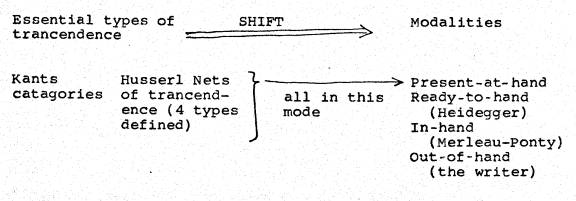
In sections two and three, I attempt to show the concrete implications of the four states of being for metaphysics by showing how it gives rise to these two subsidiary models of transcendence. And then, how the shift from one of these to the other came about as a crucial feature in modern philosophical history. In order to do this it was necessary to trace to its logical conclusion the trend of finding' different modalities by showing the existence of a fourth one to complement those already 'discovered' by Heidegger and Merleau-Ponty. Then the two models are shown to be merely different versions of the same thing, which is the icon of the four states of being. Thus the epistemological dimensions of modern metaphysics which explores different models of transcendence is traced back to the arguments of modern ontology.
In light of the appearance of the four states of being, the fundamental presupposition
of western metaphysics -i.e. ontological monism is challenged (i.e. by M. Henry). Thus a fundamental transformation
exists between the realm in which this presupposition is operative and one, which questions it (i.e. ontological
dualism). This
transformation has an effect on the four philosophical disciplines, which have a different nature and object inside
and outside that realm. Also this transformation is seen to be isometric with the actual involution
of the clearing-in-being into the knot of paradox.
Thus the four disciplines of philosophy within the realm of the
presupposition of ontological monism are displayed as a basis for a description of their ‘doubles’, which become
effective outside that realm.
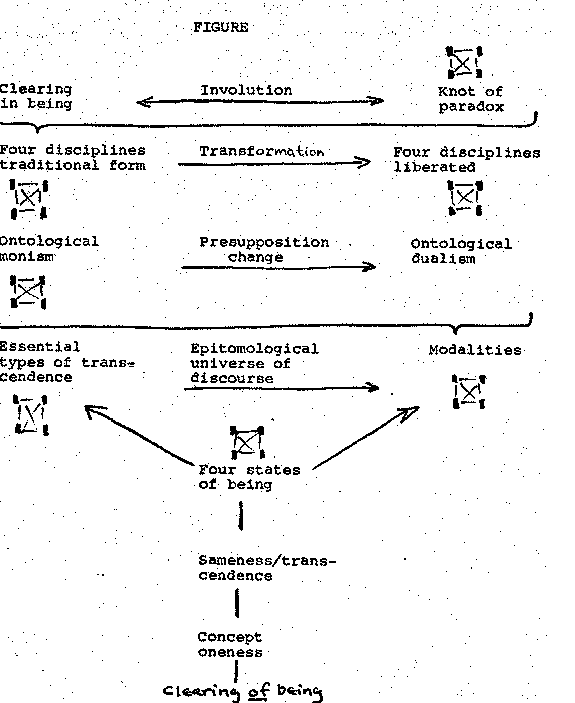
The change in the nature of the four disciplines, the change in fundamental presupposition, and the change from stating epistemological arguments in terms of types of transcendence to sorts of modalities are all seen as analogous to the involuting of the Clearing-in-being into the Knot of paradoxicality. This transformation is controlled by and based on a single ontological model prescribed by the four states of being. This ontological
10
model calls our attention to the lost concept of oneness which in turn calls
our attention to the necessity of the clearing-of-being to balance the involuting of the clearing-in-being into
the knot of paradoxicality.
This provides the basic perspective within which the unfolding of section two
must be viewed.
Part A Sameness / Transcendence
This part of section two is introductory and connective. It
introduces the major themes and provides a link with section one. It begins by defining the clearing-of-being
in terms of the states of being and the concept of oneness (as difference in unity of being). The concept of oneness is defined explicitly
by A. Blum but he does not pursue its definition in terms of states of being, except obliquely.
The clearing of being is then defined in relation to Heidegger's concept of the clearing in being. It is then considered what kind of inquiry can approach the clearing of being. At this point inquiry is divided into two sorts: Circular and linear and these are then again contrast to a third kind which 'refuses movement'. The former pair are identified with transcendence while the later one is identified with the motif of sameness. It is this latter kind of inquiry which has been named in the foregoing 'The Query'. It refuses to leave the abode of thought but only seeks to make it more its own. In this way the two motifs of sameness and transcendence are introduced. This is then given mythological underpinning by a reference to Plato's
'First law of Zeus'.
Once the two motifs have been defined it is shown that a
fundamental feature of thought is that at a certain point the motif of sameness transforms into the motif of transcendence. This
bursting of sameness into transcendence immediately articulates the universe of discourse.
This articulation is expressed in the arising of four archetypal
philosophical disciplines. Of these disciplines symbolically represent each of the fundamental motifs.
Heidegger in Being and Time
gives a definition of philosophy in terms of these four disciplines.
Ontology - Phenomenology ==
Transcendence
Hermeneutics – Dialectics == Sameness
Analytics
However it is noted how his definition suppresses one of the disciplines and
replaces it with a watered down simulacrum (i.e. analytics is substituted for dialectics). The implications of
this for Being and Time
are discussed along with the difference between analytics and dialectics. In effect Heidegger fails to use his
own insights in the theoretical structuring of his presentation of them.
This suppression is seen as a means of preventing the arising
of any more modalities that the two Heidegger discusses in Being
and Time.
Thus the problem of the proliferation of different modalities
of action in contemporary philosophy is introduced.
Part B Ontological Monism
In this part of the second section a major theme is introduced and discussed
in detail. The
framework for the discussion is a detailed commentary upon a central section of M.
Henry's book The Essence of Manifestation
in which the concept was first introduced.
The conceptions given by Henry are then applied to the model of the clearing-in-being and illustrated by examples from Hiedegger's later thought and from the work of Derrida.
A detailed analysis of the components of the presupposition of ontological monism is followed closely. It is seen how these components take on a certain pattern of inter relationship. This pattern has four segments. The extrapolation follows that it is necessary, for the argument to appear that it take on a special four part form. Thus the theoretical argument concerning appearance has to fulfill certain requirements in order to appear itself. It is noticed that these requirements involve a specific inter-relation of four elements. Thus one of the major propositions upon which the rest of the essay is founded is that there is a threshold of minimal complexity which must be passed for an object of thought to appear to theoretical
sight. Once, this points has been established then two crucial concepts are
added to it.
1. Laying
the foundations
2. Fundamental
indeterminacy
Thought attempts to 'lay the foundations' to provide itself with a solid ground as a thrust against the fundamental indeterminacy of those grounds. 'Laying the foundations' amounts to the attempt to unify the four elements of the minimal system of four segments while the fundamental indeterminacy shows up as interferences which are generated by the insubstantial grounds of thought which prevent such a unification. This impossibility of absolute clarification defines the limits of thought.
As the result of thought's inability to ground itself the concept of nihilism is, at this point, introduced. This appears in practical terms as a feature of the minimal system called minimal change - that is the constant generation of 'background noise' which is necessary as a backdrop of the appearance of anything. This background motion (irregular non-random) gets incorporated as a component into the conceptual system itself. Also, certain theoreticians attempt to dominate and remove it.
Also a major feature of the minimal system is that it is at the threshold of its appearance that inside/outside may be first distinguished and directionality appears (a major indication of inquiry's separation from the query). By means of these two features the minimal system points toward the threshold upon which it appears. This threshold itself does not appear and is thus called subliminal.
A brief excursion into Husserl's philosophy is then used as a means of solidifying
the results of this part of section two.
Given this philosophical situation in which thought tries and
fails to lay the foundations through which certain patterns of theorizing arise, it is necessary to find a means
of measuring our own immersion in the situation. The one means at hand even though it has been abandoned by modern
philosophy is the concept of oneness.
Thus at the end of this part I go back to Plato's different definitions
of the kinds of response to this philosophical situation as a basis for discovering the different definitions of
oneness that must be invoked to understand the situation.
This leads to an exposition of the concept of being or Parmenides,
and the Stranger of Elea’s proof of the existence of non-being.\
In this way a positive definition of the situation is formulated
that accounts for its constant shifting and indeterminacy.
So here the concept of the non-nihilistic basis of nihilism is
breached for the first time. The nihilistic situation of indeterminacy has a positive effect.
1. It
provides the background "noise" that is necessary for anything to appear
2. In
its constant change it is continually indicating oneness that lies beyond the flux.
Part C
Phenomenology/Ontology
With this part begins the in-depth study of the four philosophical disciplines
as they appear in the articulation of the universe qf discourse of modern philosophy.
Phenomenology and ontology are the reciprocally related icons
of the motif of transcendence in modern philosophy.
By them we are led to a concrete discussion of 'laying the foundations'
(the fundamental act of grounding transcendence) in terms of Kants attempt to ^do just that. Kant’s formulation
of the problem of laying the foundations is 'read off' by way of Heidegger's interpretation.
Part D Hermeneutics
First hermeneutics is seen in the context of the phenomenology / ontology reciprocality. Then
another major theme is introduced.
This is the concept of manifold.
This concept is defined in terms of Kant's philosophy and
especially the project of laying the foundations.
Also the manifold is laid out as the context of the minimal system. By
means of the manifold the interpretation of the minimal system is made possible.
Once the context of interrelation has been defined then a precise exploration
of what is meant by the term in modern ontology is undertaken by means of an exegesis of the relevant text from
Being and Time.
This leads to an understanding of the meaning of semiotics in the context of
modern philosophy.
Part E Dialectics
Hermeneutics transforms itself into dialectics by the consideration
of the effect on it of time. The concept of dialectics is explored in detail using Sartre's Critique
of Dialectical Reason as the point of departure. Then its further connection
to the concept of structure is unearthed perhaps for the first time. This leads to the positing of a model of the
complex system of signs which appears in the clearing-in-being. By this model it is shown that open and closed
systems are merely two aspects of the same thing. By the laying out of the model of the semiotic system we come
to the end of the search for what lies within the clearing-in-being which it has been the principle aim of this
section to bring out.
Part F Foucault's Order
of Things
Having thus laid out the semiotic system it is only left to understand its
development within the clearing-in-being.
In order to do this a long detailed exegesis of Foucault's book
is given in terms of the minimal systems development into the semiotic system.
In this way the principles of hermeneutics and dialectics put
forward earlier are shown their efficacy, and Foucault's book
is interpreted from a perspective which might be unexpected.
By this interpretation a first approach toward an understanding of ideation
is made, its foundation in mnemonics, and its dependence on the manifold.
Part G Zolla: Oneness as an idea
Since oneness was used as our measure of ideation, it is only natural to concentrate
next on a text which takes the idea of oneness as its object. Unexpected results also follow from this interpretation.
Part H Knot of Paradoxicality
This part serves to reiterate in a different context
many of the foregoing themes.
The clearing-in-being turned inside out
and seen from the outside is a knot of paradoxicality. At the end some suggestions are made concerning the transformations
of the four disciplines outside the realm of ontological monism.
Section III
Having explored the landscape of the clearing-in-being in detail discovering its major features (i.e. the minimal system and its expansion into the full semiotic system) and postulating a model of its limits (i.e. the manifold); it is possible to turn our attention now to the most important feature of the clearing-in-being. This is called among other names the "Boundary". The boundary is not just the threshold of appearance but is its idealization. It is the threshold of the appearance of ideas. As such it does not lie within the clearing nor at its limits described by the model .of the manifold. In fact its precise location is taken as a problematic. It is effervescent and must be approached in such a way as to catch a glimpse of it without reifying it conceptually. A great deal of this section is devoted to catching a glimpse of the boundary. Another major theme of this section is what is called the Heidegger illusion. This is the name given to Heidegger's attempted solution to the 'problem of transcendence' by an appeal to modality. The development of the universe of discourse of philosophy which allowed such an attempt (that set it up as a problem to be solved), is one of the most interesting developments in the history of philosophy. The roots of the Heidegger illusion is traced back through Husserl to the original setting up of the universe of discourse in which transcendence is a problem by Kant.
A third major theme is the transformation of the sameness/transcendence motifs into skepticism / nihilism. That is from a vague philosophical problem into an existential situation.
The fourth theme is the further development of the concept of the manifold and its explanation using a suitable thought icon. That is the icon of dimensionality by which the relationship between the 'manifold' and the concept of oneness is explored in depth.
These four major themes are woven together to form the substance of section
three, part A attempts to set the stage for a first approach toward the boundary by contrasting two philosophers
encounters with the groundlessness of thought. These philosophies
are those of Descartes and Heidegger. They are discovered to be
reciprocally related in many ways. An attempt is made to glimpse the boundary between their two approaches toward
it. In
Part B a second attempt to glimpse the boundary but this time instead of from between two philosophers it is from
between two outcast philosophical positions, those of skepticism and nihilism. With Part C a third more complex
and longer approach to glimpsing the boundary is begun which will encompass the rest of the section. This approach
begins by an in depth look at Husserl's philosophy. That philosophy can be seen to have two major models which
form its backbone. The first is a model of transcendence - in the forerunner of the model presented by Heidegger
and jasper - is it called Husserl's "Motif". The second is the several essential types of transcendence
by which he elaborates that model progressively in the Logica1
Investigations.
In this part of the paper I pre-sent the cores
of both models.
Part D is then a radical attempt to step back to the origin from
which the whole problematic set up by these two models arises.
In it the idea of oneness is given an interpretation stemming
from my own study of oriental philosophy. The idea of oneness is interpreted as interpenetration.
Interpenetration means every speck of the dust of creation contains within it all of creation in reflection. This concept is then connected to the setting up of the universe of discourse of modern philosophy by Kant with his distinction between infinite and finite knowledge. Then a concrete thought icon taken from the western tradition is developed which ties together the manifold and the idea of oneness as interpenetration. Part E develops this synthesis of themes by giving the idea of the manifold a relativistic (cf Einstein) interpretation. By looking at it in terms of space/time its connection to the form of the idea, the Husserl motif and certain themes developed by Merleau-Ponty becomes apparent, Part F remains unwritten but if completed it would specifically show how Heidegger's philosophical illusion was rooted in Husserls Logical Investigations. This is an important exploration of a crucial stage in the unfolding of the universe of discourse of modern philosophy, At this transition point the essence of the whole tradition may be glimpsed. For there^ Heidegger attempts to solve the problematic set in motion by Kant which he in turn took from scholastic philosophy. Part G is a deep exegesis of the architectonic of^ Kant's philosophy revealing the sub-structure of the boundary which is called the limit of reversibility. the universe of discourse set up by Kant unfolds, the assumptions originally packed into it by Kant which were not noticeable in his own time become important. Many themes in Merleau-Ponty's exploration of the sub-structure of the idea are revealed by a detailed study of Kant's original posting of the universe of discourse in the Critique of Pure Reason. By comparing these two end points important - not easily discerned-aspects of ideation become apparent. By means of these it is possible to give a final definition to the boundary and glimpse its structure.
In the whole of section III an allusion is made to a further
theme which will only properly be developed in the next section.
This is the concept of intra-penetration as a balance
to inter-penetration. Because
oneness is here still
only an idea it must conform to the form of ideational processes.
By means of this further concept we are led back to an even deeper
study of the concept of nihilism which takes place in the next
section.
Part A
Two philosophical encounters with groundlessness.
In this section two different philosophies, those of Descartes and Heidegger
are appraised in terms of their approaches to groundlessness. To Descartes groundlessness appears
primarily as oblivion. Therefore it is the primary objective of the first segment of this part to uncover the model
of the sphere of oblivion with a droplet of oblivion in the centre. Kant takes this model over from Descartes and
makes it the basis of his philosophy by applying the idea of infinity to it. And it is also this model which eventually
is turned into the clearing-in-being / knot of paradoxicality and which finally is transformed into the manifold
by which the absolute limits of the clearing-in-being is defined.
Because groundlessness appears as oblivion to Descartes then anamasis becomes
the basic movement of his philosophy. All philosophies may be classified according to whether anamasis plays a
central role or not. For all the great ones its role is vital. Thus it is for both Heidegger and
Descartes. Since
groundlessness first appears as forgetfulness it is a major theme of this section and indeed in the whole of the
rough draft to show the importance of its opposite i.e. memory as re-collection.
The segment concerning Descartes ends in a hermeneutic exploration of Descartes
famous dream in which the seed of his "admirable science" was revealed to him. The substance of that
dream is taken to substantiate the interpretation given to his 'meditations' in this part.
Next the theory of recollection as it appears in Heidegger's own philosophy is explored. Thus a depth exegesis of the section of Being and Time on the call of conscience is made. This also reveals Heidegger's stance toward groundlessness although he does not conceive of it as oblivion but instead as 'nothing'-ness. This gives a context for the exploration of the meaning of Dasein.
Continually throughout the part comparison is made between the approaches of these two philosophies to groundlessness. Neither approach is taken to be definitive. Rather groundlessness takes on different qualities through different approaches to it. This is shown at the end of Part A when a completely different approach is displayed based on the form of the axiomatic platform. Part B skepticism, Nihilism and Death
In Part A the sameness/transcendence twinned motifs were presented in terms of the difference between philosophies of 're-collection' and those in which amanesis plays no central role. In this part these same twin motifs are re-presented in another fashion. This time in terms of the existential relationship between man and the landscape in which he finds himself. I posit that the correct attitude toward a nihilistic landscape, that is a situation in which groundlessness is so epidemic that it appears as a feature of world about us, is skepticism. Skepticism however here is meant explicitly as the 'philosophy' propounded by Sextus Empiracus. Most of this part shows how this attitude of skepticism is a response to nihilism. By considering skepticism / nihilism together another approach to groundlessness is revealed with each approach different qualities of it are revealed.
At the end of this part the themes of recollection / oblivion and skepticism
/nihilism are drawn together by a consideration of the role of death in these philosophies. The philosophical conception
of death leads directly into a definition of the concept of structure and an exploration of the assumption
upon which this definition is based.
Part C Husserl: The motif and nets of transcendence
The true philosophical source of structuralism is Husserl’s philosophy; specifically his concept of essence perception. Therefore the argument moves from the philosophical conception of death to structuralism to a consideration of Husserl’s philosophy.
Husserl’s philosophy is then considered in relation to the path by which the argument of the section arrived there. Husserl is characterized as an immature skeptic (one of the stages in the life career of the true skeptic) and his philosophy is considered structurally (that is in terms of what Dasein calls detachment which is a major premise which structuralism is founded on).
By approaching Husserl in this manner three themes arise for consideration.
1. Theory of the manifold
2. The motif
3. The nets of transcendence
1.
Husserl takes the theory of the manifold in Kant's work and develops
it in an unexpected way. One would scarcely think the two were connected.
Husserl sees the manifold as the basis of the interrogation of
the entire panoply of scientific theory. This only makes sense in terms of a structuralist interpretation of what
Husserl says about the nature of theory and it is seen that the manifold is the basis of structuralism.
2.
The motif is taken with a double purpose in mind.
First it is Husserl's model of transcendence:
The forerunner of
that Heidegger and Jasper's present us with.
Therefore, by means of it we can get an idea of what that more sophisticated model is based on and by exploring it we can get an image of how western philosophy conceives of ideation. Models of transcendence are essentially pictures of how ideation works.
Secondly by looking at the specific example of Husserl’s modeling of transcendence chosen it is possible to see in his argument the roots of the ready-to-hand and in-hand modalities. Thus the concept of these modalities were already implicit in Husserl’s work and this is a main point in this part of section three.
In order to show how the concept of modality is embedded in Husserl’s work brief forays are necessary into the work of Heidegger and Merleau-Ponty to pick up terminology and examples.
3. The model of transcendence given by Husserl is elaborated by him in his Logical Investigations by interpreting it in terms of different kinds of transcendence. These four types of transcendence added to the motif I have called the nets of transcendence. In order to get a clear picture of them in relation to each other I have extracted them and considered them together by way of a single scheme. This scheme is the basis for the development of the rest of the section.
Thus at the end of Part C the argument of the rest of the section is put forward. This argument has two parts:
DEPTH Relationship of Husserl and Heidegger to Kant
SURFACE Relation of Husserl to Heidegger - The former providing the basis of
the latter’s illusory solution to transcendence.
Part D Interpenetration and the icon of dimensionality
The depth aspect of the argument is considered first. It begins by a radical re-appraisal of the basis of modern philosophy. Kant set up that basis by distinguishing finitude and infinity. The inner structure and meaning of this distinction is explored first and its relation to the schema of the nets of transcendence. It is then shown how this model makes necessary the assumption of a realm of pure immanence to balance the nets of transcendence. Pure immanence is re-defined, based on Buddhist philosophy, as interpenetration.
This gives a concrete sense to what might seem utterly vague and indeterminate
to us in Kant's argument and it ties the discussion to the exploration
of the idea of oneness. However it is not desirable to jump from the occidental philosophical tradition to the
oriental, so an icon of these ideas is searched for and found among the standard theoretical machinery in the
Western tradition. This is the icon of dimensionality.
This thought icon is developed in great detail. There are two specific themes this icon makes it possible to explore, one is the relationship
between Husserl’s motif and ideation's finitude. This brings to light another model of the motif in terms of space/time:
That of the interval. The second is the concept of the manifold.
Part E The manifold and its intervals in Kant's philosophy
The results of the foregoing section are then read back into Kant's philosophy. By this reading a wholly different perspective on Kant's philosophy and especially its architectonic is gained, if the ideal of hermeneutic understanding is to comprehend an author’s work beyond what
he himself comprehended in it, then this ideal is fulfilled in
this section.
The major concept developed within this part is that of the quadratic interval. This is a thought formation which is at the root of all contemporary philosophy. It becomes particularly important in the fourth section.
Also in this part is shown the roots of the Heidegger illusion in Kant's philosophy. This might be said to be the
most important function of this part.
Part F
The roots of the Heidegger illusion in Husserl's Logical Investigations
This part although outlined lies unwritten. Its object is to show how the architectonic of Husserl's Logical Investigations as it builds toward the definition of the transition from noematic nuclei to idea via the essence has precisely the same form as Heidegger's illusion. And how Heidegger merely took that form and simplified it bring out the assumption of modality upon which it is based. This involves beginning with the Husserl motif and adding each layer of the schema of the nets to it until the entire structure of the architectonic of the logical investigations is laid out. A summary of this part in terms of ideational intervals is given at the end of Part E. It is interesting that this topic contains the essential insight into the relationship between the work of Heidegger and Husserl from which in a sense, all the rest of the essay flows and it is precisely this part that in the end I failed to write. Since it was sandwiched between two sections on Kant I was afraid by re-touching my knowledge of Husserl in order to write it I would forget Kant. Thus I put it off. Now that it seems
I've written too much in the wrong form I will probably not
return to it.
Part G
Boundary and limit in Kant' s philosophy
In this part the argument goes very deep into the structure of ideation following once again the hints given by Kant's architectonic. The boundary is defined in terms of the concept of the limit of reversibility. These two concepts will be further developed in section Iv in onto-logical terms. Here, however, they are seen to be the basic components of ideational model which have been put into an inessential side cupboard of Kant's architectonic (i.e. the amphiboly of the concepts of reflection).
One of the basic arguments of this part is to show how the minimal system of concepts of which Dasein is one member (along with non-Dasein, Logos, Legein) may be derived from this section of Kant's work. This forms the basis for a rigorous definition of the relationship between the manifold and the clearing-in-being. This in turn makes possible the precise definition of the novum.
Finally at the end of this part in preparation for section I've an intricate model of the 'depth' of the boundary is presented and briefly explained. It serves as a road map for the journey taken in the next section into Plato's cave, which is seen to be the place of the unfolding of ontology.
Section IV
By a glance at the preface it is possible to see that when it was written section
four did not exist on paper. There I proposed to write two further
sections after section three. The fourth would have been strictly on ontology and the fifth would have been a re-approach
to sociology based on an interpretation of Plato's republic. My
advisor Professor Martin suggested I did not write anything about sociology and there by simplifying the whole
project considerably. Thus I collapsed the part concerning the Republic together with the section on ontology.
This proved to be a very fertile combination in ways I hardly
expected. This section is particularly dense in terms of the unfolding and interweaving of ideas. But
it turned out to be the high point of the whole series of working papers that make up the rough draft. Here
having diligently defined concept after concept throughout the essay I began manipulating these already defined
concepts. Therefore the reading of this section is difficult. However, that difficulty is compensated for by the
number of unexpected concepts that I was given insight into in these pages.
Section four is ostensibly about the relationship between nihilism, the essence of nihilism (the Husk) and the non-nihilistic distinction. Interwoven with this major theme is a parody of the model of the clearing-in-being taken from the 'cave sequence' of Plato's Republic, a development of the model of the cancellation of the four states of being, and a precise modeling of the life form of the idea / mirage. All of these diverse conceptual models are different approaches to the same ontological question. That question is the effect of nihilism at the ontological level. In spite of nihilism’s pervasiveness forms do appear, life goes on even if by dint of nihilism's effect it is not worth living. Life as merely (un)-livable is called 'The Husk'. The Husk arises because nihilism in its essence is not nihilistic (as Heidegger says). Therefore nihilism, implies the existence of a non-nihilism and these two I add imply an a-nihilism. That is they imply the possibility of making a non-nihilistic distinction. Current ontology reaches, even if it is unclear about its aim itself, toward the definition of this possibility. Thoughts inherent nihilism (groundless-ness) when not directed by the heart attacks the Husk of Life as (un)-livable continually. Because of this the threshold of appearance, which becomes when infinitized the threshold of the appearance of the idea, becomes the centre of attention. However, what is seen as the ruthless attack of nihilism on life from another perspective may be seen as the desperate attempt of ideation to seize the non-nihilistic distinction that makes life worth living. Thus the problem of nihilism is only comprehensible when the life form of the idea/mirage is seen in relation to it. This life form of the idea has its ontological basis in the model of the cancellation of the four states of being. The life form of the idea is essentially a sustained illusion. Illusions have no substance but have a life as a concatenation of circumstances, which make it appear as if something substantial were involved in producing the effect. The model of the four states of being show how this illusion is produced and how it appears to have being but in fact all the states of being cancel. Because of this ontology is really an empty science which appears as an
adjunct to ideation in order to ground it. In truth the cancellation of the states of being shows that by ontologies own principles the beings of the phenomenal world have no 'Being'. Thus the clearing-in-being is illusory as well since it is only the semiotic level of deterioration of the life form of ideation. This is what justifies the parody of the clearing-fn-being by Plato in his Republic. There we see how the magical trick of sustaining the illusion works as an inter-subjective affair.
The life form of ideation is seen clearly only by the delineation of the concept
of oneness and this calls for the definition of intra-penetration as a balance to the concept of inter-penetration.
Intra-penetration is seen to be the substance
of Merleau-Ponty's Wild Being, which necessitates the definition
of a fourth modality - the Out-of-Hand.
This modality is my own addition - the rest of the concepts of
modalities, states of being etc. come from the work of other prominent philosophers. This work though it offers a completely different viewpoint
on the significance of western philosophy must indeed be termed RE-SEARCH. This fourth section
leads us to approach again the model of Merleau-Ponty called in section I the apparatus. Through it a completely
different view of the clearing is gained.
It is seen that
although cancellation is the result of the relation between the four states the process of cancellation is not
without effect. This effect is called clarification, which is
the ultimate result of the whole ideational process. What is clarified is what lies 'before' or 'beyond' the point
where the threshold and that which appears on it chiasmically
separate. The whole model of ideational clearing may be seen as an attempt to define this 'phase' of being which
is wild which lies 'before' ideation and the clearing arise. The heart of Merleau-Ponty’s 'apparatus' is called
crystallization. Crystallization
and constellation defined by Adorno in Negative Dia1ectics are two different versions of
the same idea. They are both means of approaching what occurs in the region of Wild Being.
By them ontologists have turned metaphysics upside down and taken
as their tool a highly sophisticated form of the Heidegger illusion. Instead of it being a solution to the
problem of transcendence it has been converted into a basis for creating an ontology based on de-transcendence
(cf. O'Malley, Sociology of Meaning).
This means that instead of a boundary
being posited so that the problem becomes now to get across it without breaking it; the question becomes now did
the boundary get to be posited in the first place and what is the state of affairs if it is never posited. The
state of affairs is seen to be a sophisticated version of the Heidegger illusion in which the unfurled problematic
of transcendence has been rolled back up into the model, in much
the same way as Gauss put the co-ordinate system within the 'worldline.' Gauss
would find
his
bearings by
the geodesic worldline instead of filling all space
with the coordinate system.
Part A introduces the concept of the clearing-in-being as a sustained illusion
like a mirage formed by the process of ideation, and shows a parody of this by liking it to
the four cities founded by Socrates in the Republic showing how the whole model is a mechanism for producing nihilism.
Part B goes on to show how the production of nihilism has a function in that it allows things to be seen. The problem of nihilism therefore centers around the definition of thresholds of appearance. The model, which allows things to be seen, must itself change in order to be seen itself. A recent transformation undergone by the clearing-in-being is its re-definition in terms of Merleau-Ponty's transversal model. By this re-definition the clearing-in-being has been highlighted in a different way showing up its relation to the 'basis' or essence of nihilism more starkly by creating a difference between the two models of the highlighting of the clearing-in-being.
Part C uses this difference as a point of departure for a depth exploration
of the boundary of the clearing. Every threshold represents a transformational lacunae, therefore the nature of these features of the ideational landscape (epigenetic) is considered
in detail.
Part D develops a concrete metaphor for the scintillation of the threshold
taken from particle physics (much the way the icon of dimensionality was developed).
Part E explores the nature of the scintillation themselves and what they tell
us about what lies beyond the level where they separate from the threshold of their discernment. This part develops
the concepts of crystallization and constellation (Merleau-Ponty and Adorno).
Part F is unwritten but would be an exploration of the non-nihilistic distinction
in detail based on a rereading of "The Apology" by Plato. That is a trial by the city of a man
who has claimed to have been able to make non-nihilistic distinctions.
Part A
This part begins by speaking of the way the eastern metaphysical concept of interpenetration has recently been taken as an image of diacriticality and how such comparisons are inane although they tell us something about the direction of thought being taken by those who are developing the diacritical / detotalized / teleonomic / open system. Knowing this direction gives us a means of looking at the mirage created by the ideational process. Also it is seen how all descriptions of what is beyond the life form of ideation (in which we are embedded), such as interpenetration, are only pictures of how this life form works.
Given the life form of ideation and the impossibility of going beyond it by any means within it, the problem becomes 'how is this in-escapable illusion sustained' particularly in the face of nihilism which is the product of its over consumption/wastage syndrome that is endemic to it. Thus the question becomes how is life sustained in the presence of nihilism, i.e. what is the essence of nihilism. This is very much like the question of how the forms are sustained if everything is in fact interpenetrating although the life form makes it appear otherwise. Under the auspices of ideation the concept of oneness as interpenetration must submit to twinning. Thus the concept of intra-penetration is produced to balance the former concept of oneness and explain how the forms are held intact. This solution to the problem of the sustaining of forms in the face of interpenetration gives a hint of the answer to the problem of how life is sustained within a life form of ideation in the face of nihilism. This calls to the fore the concept of the possibility of a non-nihilistic distinction.
Next the parody of the clearing-in-being given in Plato's Republic in terms of Socrates founding of four cities in hell. The development of the ramifications of this parody serve as a background to the entire section giving a skeletal frame work to hang the interweaving ideas onto. The crucial question concerning the cave metaphor is how the ascent of Glaucon occurs. This is as much as asking the relation between the life form of ideation and the concept of inter-intra penetration. If it is conceived that Glaucon passes a threshold between the two then the question becomes how thresholds are set up in the first place in order to be crossed. The life form projects its opposite - the "idea" of oneness as developed by metaphysicians and by a balance between them the metaphysics of ideation is sustained. The question of the life form comes down to the question of how the threshold by which what is 'inside' and 'outside' the life form is produced. The question of the threshold is no small point since all of western philosophy and science is founded on the concept of a transformational lacunae. This assumption is even deeper than that which sets up the alternatives of ontological monism/dualism. What is 'inside' the transformational lacunae? How are they produced? What is their function? This is the central question all metaphysics is aligned to try and answer. This is the furthest reach of the frontiers of metaphysics.
It is found that the progressive collapse of ideation makes possible the exploration
of this question. As nihilism intensifies to its ultimate limit (i.e. the clearing-of-being) the world dilates
(in-hand) and recoils (out of hand).
By this action of progressive solidification the transformational
lacunae are 'squeezed' thus creating marginal regions.
By the exploration of these marginal spaces we learn about the
metaphysical constitution of the region of Wild Being. This process of solidification also gives rise to the phenomena
of embedding which is the source of the quadratic interval.
Part B
To approach the phenomena of embedding it is necessary to understand what Heidegger calls "en-framing" which is the give and take of disclosure/withdrawal by which being 'appears' to us. With every appearance something is hidden. It is en-framing which is the metaphysical expression of the twinning upon which ideation is based. This en-framing creates the transformational lacunae as places where we don't know what is going on. So to find out what is inside the transformational lacunae we must either crack the Janus Head en-framing which is set up or explore the margins where shrinkage occurs. The en-framing seem to be set up to obscure the non-nihilistic distinction. It is precisely this built in uncertainty / imprecision which seems to prevent our making non-nihilistic distinctions. Thus by locating the one we have narrowed down the area in which we must search for the other.
At this point I turn back to the commentary on the visible and invisible in
preparation for completing the commentary on the section that describes the 'apparatus' begun at the end of section
I. In this commentary I unearth the form of the quadratic interval which the enframing appears
as a two dimensional projection of the full form by which the enframing appears in quadratic form is called the
'en-framing crystal'. By defining the en-framing crystal the full form
of the Idea//Mirage is brought to light so that the whole problem of the relation of nihilism to its essence (the
Husk) may be re-defined in relation to a concrete thought icon.
It is in terms of this complex model that the non-nihilistic distinction
may be precisely defined.
Part C
The quadratic interval defines the margins of the shrinkage of transformational
lacunas. In
science this shrinkage appears as the definition of emergent levels (i.e. life/molecule/atom/particle/quark) of
constituted topics of investigation. These margins form a network that coheres as a sui generis phenomenon. This
network forms something like what C. M. Waddington calls an attractor surface in Tools
for Thought. The attractor surface by which the teleonomic
system is righted on its course which it is put out of balance is defined by what Merleau-Ponty calls hyper-reflectivity. That is the boundary, so painstakingly defined
in section three, when it folds through itself.
It is this intensified reflectivity which is the source of the
teleological functioning of the complex semiotic system.
By defining hyper-reflectivity as the dilation and recoil of the
boundary by which scintillations are produced an access is gained to the phenomena of scintillation which would
otherwise not be available. From this crucial definition the argument
moves to a consideration of Heidegger's essay "The Question of Being". By means of its exegesis a clearer
picture of the quadratic interval and the baffle of hyper-reflectivity.
Particularly, attention is given to the transition from one interval
(i.e. Epoch of being, of Heidegger; episteme, cf Foucault) to another showing how the model of the quadratic interval
describes these transformations.
Part D
In this part a concrete icon of scintillation is taken from physics. This thought
picture is of virtual pro-cesses. This model is built upon the conception of the four states of being and serves
as a means of approach to the process of their cancellation. Consideration of scintillations as virtual processes
leads to the con-sideration of the trace structure that underlies the semiotic system.
Part E
This part draws all the themes of the foregoing together by making an explicit
analysis of the four states of being as a model of cancellation. The positive aspect of cancellation
is clarification. Thus
the model of the states of being serves as a definition of wild
being - the clarified realm. The means of access to this realm are limited by the
fact it is covered over by the en-framing crystal/quadratic interval formation founded on the trace structure.
However the formulations of crystallization and constellation are discussed
in detail and the access they offer surveyed. The culmination
of the part is a depth look at the Merleau-Ponty apparatus introduced at the end of section one.
The whole concept
of the clearing-of-being as the logical end of the clearing-in-being
derives from the working out of the implications of this model
which provides a transversal view of the clearing-in-being.
Part F
Part F is unwritten but would as has been noted be an in-depth look at the
idea of the non-nihilistic distinction based on an exegesis of Plato's The Apology.
Socrates purported
to be, such a one as who could make such a distinction. His
trial by the city is a parody of the relationship between ideation and its antithesis.
That is the one who discriminates in a way which is unaffected
by groundlessness. Groundlessness and nihilism point toward the possibility of making non-nihilistic distinctions. The
whole question then becomes how do we escape the mires of ideation and get out of
the dialectic of nihilism - anti-nihilism, a-nihilism (nb. technosis,
anti-technosis, a-technosis; Biram) to the reality which it indicates
by leading us to perplexity.
How do we move from Socrates position of one attempting to destroy ideation
by pointing up its inner contradictions to the position of Laotzu who is free from it altogether. Laotzu says:
One who excels in traveling leaves no wheel tracks.
Tao Te Ching
Thus ideation founded on the trace structure does not arise in the one who
follows the way.
EPILOGUE
This will I am sure remain unwritten as well. It was to a depth structural/hermeneutic analysis of Beowulf and Gilgamesh along the lines of the previous interpretations I have done on the Song of Songs, Tao Te Ching, and Beowulf. That is reading them as metaphysical texts couched in metaphor. I intended to use them as a framework for restating the major themes of my dissertation and in particular exploring the theme of "Glory" as a lost way of perceiving existence which gives existential sense to the concepts of Novum and clearing-of-being as the experience of what in eastern metaphysics is called white light. Also the point of these texts being selected is to show that the selection of avant-garde texts of literature for semiotic/ structural analysis is inane because the texts say the same 'as the analysis (i.e. the disintegration of subjectivity). It is only texts on the oral/written' culture borderline that provide us with a counter example to the life form of the Idea//Mirage which we are so hopelessly lost in. In cultures in which glory was a real thing, which was perceived communally - although ideation existed it did not dominate the whole of these peoples existence. Wealth was real - land, cattle, gold instead of being signs on paper, for example. By the counter example of these peoples for whom ideation was a whole thing and a tool among others for coping with existence it is possible to take our bearings.